How to Check If Someone Bought Instagram Followers: 7 Signs
Quick answer
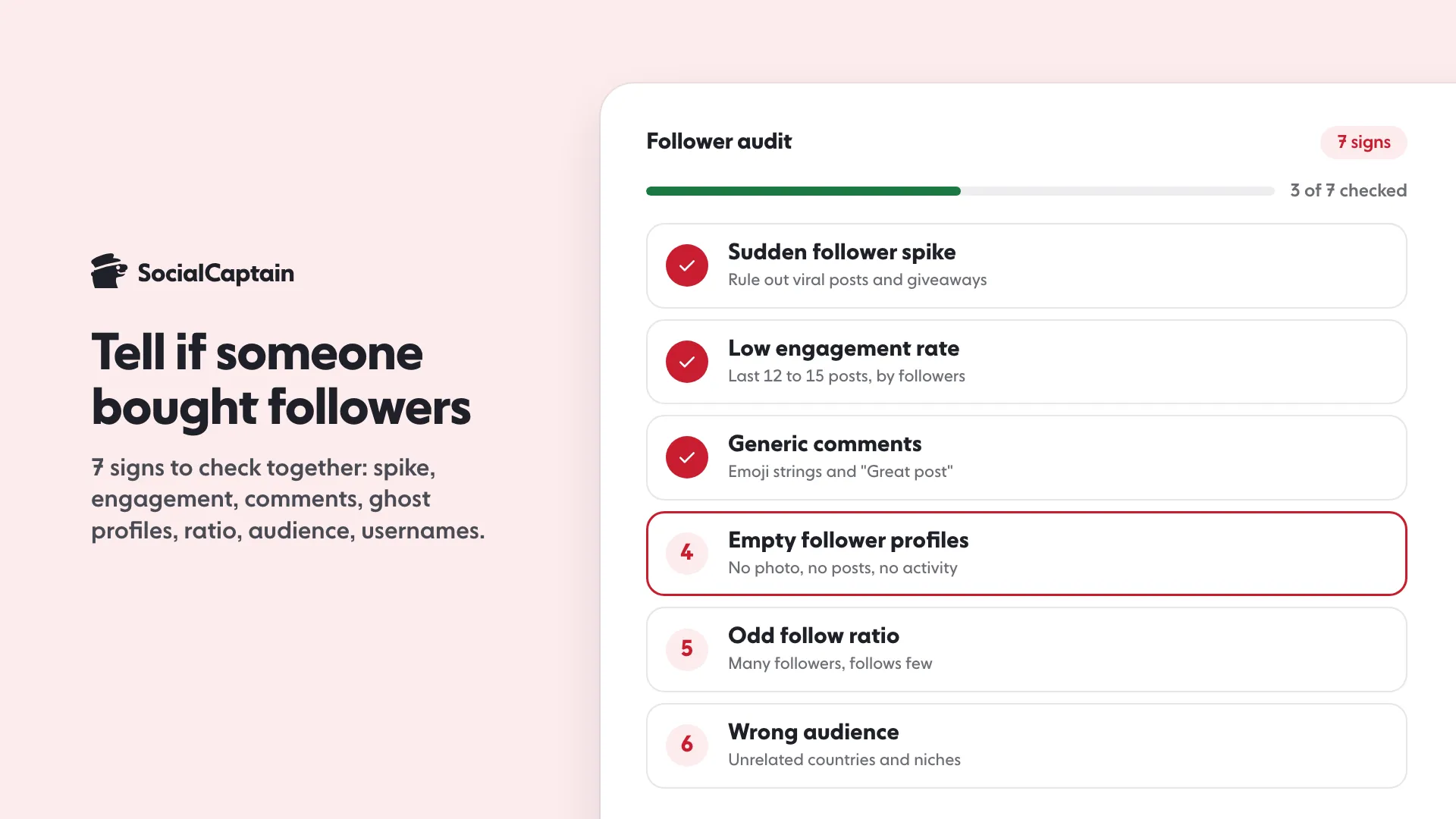
To tell if someone bought Instagram followers, check 7 signs together: a sudden spike, low engagement rate, generic comments, empty follower profiles, an odd followers-to-following ratio, a mismatched audience and random usernames. One sign proves nothing; several together form a strong pattern.
- Engagement rate is average interactions per post divided by followers, times 100.
- Rule out viral posts, press, reposts and giveaways before suspecting a spike.
- Review the last 12 to 15 posts, not just one.
On this page7 sections
You can tell someone bought Instagram followers by checking 7 signs together: a sudden follower spike, a low engagement rate, generic comments, empty follower profiles, an odd followers-to-following ratio, a follower base that does not match the account’s market, and random usernames. No single sign proves it, because most have an innocent explanation. Several at once make a strong pattern. This guide shows how to check each one in a few minutes.
How do you check if an account bought followers?
Open the account and gather three things before you judge: its follower count, its last 12 to 15 posts with their likes and comments, and a sample of its followers list. One influencer-audit guide recommends reviewing the last 12 to 15 posts, so one lucky or flat post does not decide the result. Then go through the 7 signs below.
Treat the result as a pattern, not a verdict. Audit guides make the same point: a low engagement rate does not necessarily mean followers were bought, but it does warrant some investigation.
What are the 7 signs of bought followers?
1. A sudden follower spike
A sudden jump in followers with no obvious reason is the classic sign.
First rule out the innocent causes. Viral content, press coverage, reposts by bigger accounts and giveaways are the usual ones. If none of those fits, look at what happened next. If posts after the spike got no extra likes or comments, the new followers are not watching.
2. A low engagement rate
Engagement rate is average interactions per post divided by total followers, times 100. Take the last 12 to 15 posts, add likes and comments, divide by the number of posts, then divide by followers.
For example, 10,000 followers and an average of 55 interactions per post gives 0.55%. Compare that with accounts of the same size. One published benchmark puts engagement rates between 0.95% for accounts with over 100K followers and 4.21% for accounts with fewer than 5K followers. Far below the range for its size is a flag. The free engagement rate calculator does the arithmetic.
3. Generic or spammy comments
Read the comments. Comment sections made up only of generic, irrelevant or spammy remarks, such as strings of emojis or “Great post”, are a major warning sign, according to influencer-audit guides. Real comments refer to what the post shows. If unsure, open the commenters’ profiles.
4. Empty follower profiles
Open the followers list and tap through a sample. Ghost profiles have no posts, very few followers and little or no activity. A missing profile photo is also unusual. A few empty profiles are normal, since some people only watch. If many followers are ghosts, that suggests fakes.
5. An odd followers-to-following ratio
Check the follower and following numbers on the profiles in your sample. A profile with a huge number of followers that follows only a few accounts could be fake. Mega-celebrities are the exception, because many people follow them for real.
6. An audience that does not match the account
Scan the followers’ bios, locations and content. If a large share sits in unrelated countries or niches, the audience does not fit. A local bakery whose followers are mostly abroad and unrelated to food is suspicious. Mismatched demographics and niches are a reason to look closer.
7. Random usernames and empty bios
Odd usernames and bios are among the common attributes of fake followers: random strings of letters and numbers, copied celebrity names, and empty or nonsensical bios. Seen across dozens of followers rather than one, this is a pattern.
How do you read the signs together?
| Signs you find | What it suggests |
|---|---|
| One sign only | Not proof on its own; check the other six |
| A spike plus low engagement | Followers arrived and did not react |
| Ghost profiles plus random usernames | Many followers are not real people |
| Generic comments plus a mismatched audience | Fake engagement from fake accounts |
| Several signs together | A strong pattern worth a closer look |
Pods are a separate case. Auto-like groups inflate engagement too, and belonging to one can go with bought followers.
What happens to an account that bought followers?
Instagram says it acts on inauthentic activity. In its November 2018 announcement on reducing inauthentic activity, it says it will remove inauthentic likes, follows and comments given by accounts that use third-party apps, and that it has built machine learning tools to identify those accounts. It does not describe how its detection works in that announcement.
Instagram also says accounts that keep using such apps may see their experience impacted. The announcement covers activity those accounts give to others. It does not say that followers an account bought are removed. Instagram Monetization: 5 Built-in Tools and Requirements lists the tools an account can use, and why a real audience matters for them.
What if you are checking your own account?
Run the same 7 signs on yourself. Sample your followers list and remove spam accounts, and look at your engagement rate over the last 12 to 15 posts. If a seller ever asked for your password, change it now: Instagram says you can change your password to revoke an app’s access.
If you want followers that pass these checks, the audience has to be real people who match your niche, country and interests. Buy Instagram Followers: Real vs Fake and 7 Checks explains how to judge a seller before you pay, and Instagram Bots: 5 Things They Do and the Risks of Each covers tools that act on your account. SocialCaptain delivers real people who match your niche, country, language and interests; see pricing.
FAQ
How can you tell if someone bought Instagram followers?
Look for 7 signs together: a sudden jump in followers, a low engagement rate, generic comments, empty follower profiles, a large gap between followers and accounts followed, a follower base that does not match the account’s market, and random usernames. One sign alone is not proof.
What engagement rate is suspicious?
Compare the account with others of its size. One published benchmark puts engagement rates between 0.95% for accounts with over 100K followers and 4.21% for accounts with fewer than 5K followers. A rate far below that range deserves a closer look, but it does not prove followers were bought.
Can you see who someone’s fake followers are?
You can open their followers list and check the profiles. Accounts with no photo, no posts, few followers of their own and a random username are typical of fake followers. A few such accounts are normal; many of them is a warning sign.
Can a sudden follower spike be innocent?
Yes. Viral content, press coverage, a repost by a bigger account or a giveaway can all bring a spike. Rule those out first, then see whether engagement rose with the follower count.
Does Instagram remove bought followers?
Instagram’s November 2018 announcement says it removes inauthentic likes, follows and comments given by accounts that use third-party apps, and that it has built machine learning tools to identify those accounts. It does not say it removes the followers an account has bought, and it does not describe how its detection works.
Sources
- Removing Fake Likes, Follows & Commentsabout.instagram.com
Related guides
Growth services
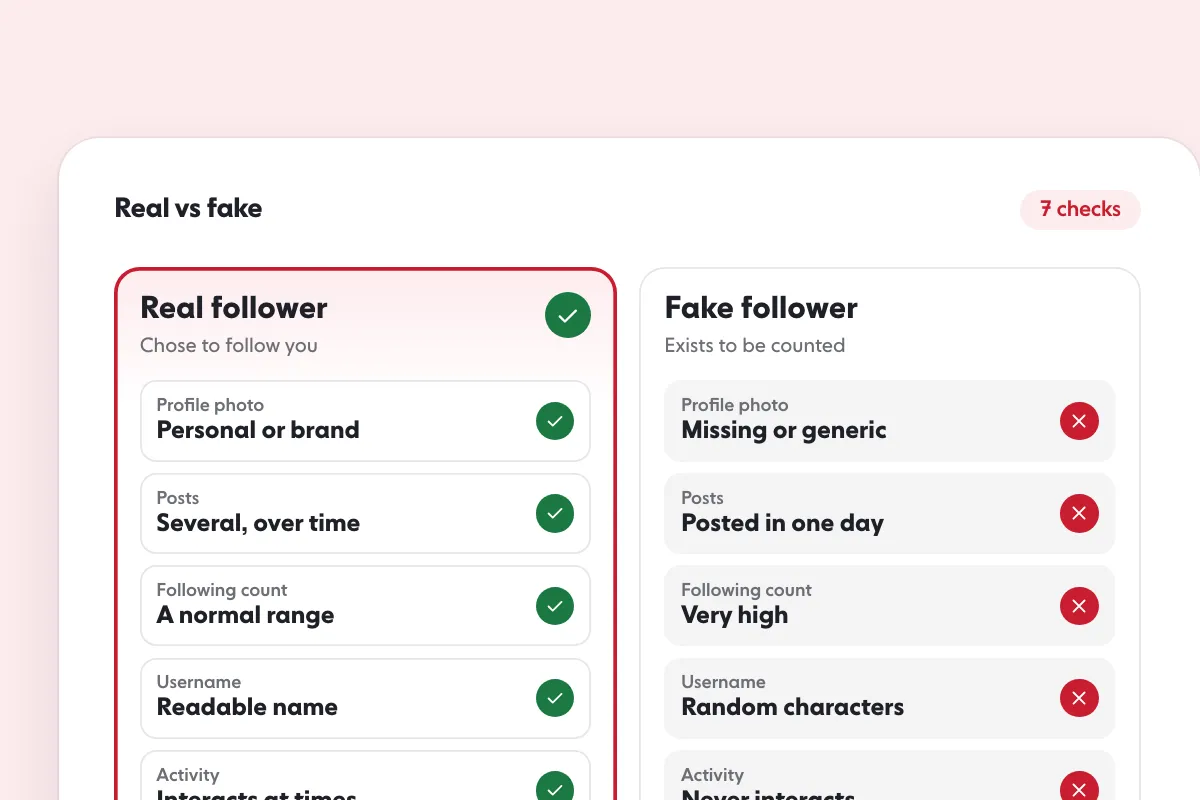
Buy Instagram Followers: Real vs Fake and 7 Checks
Growth services
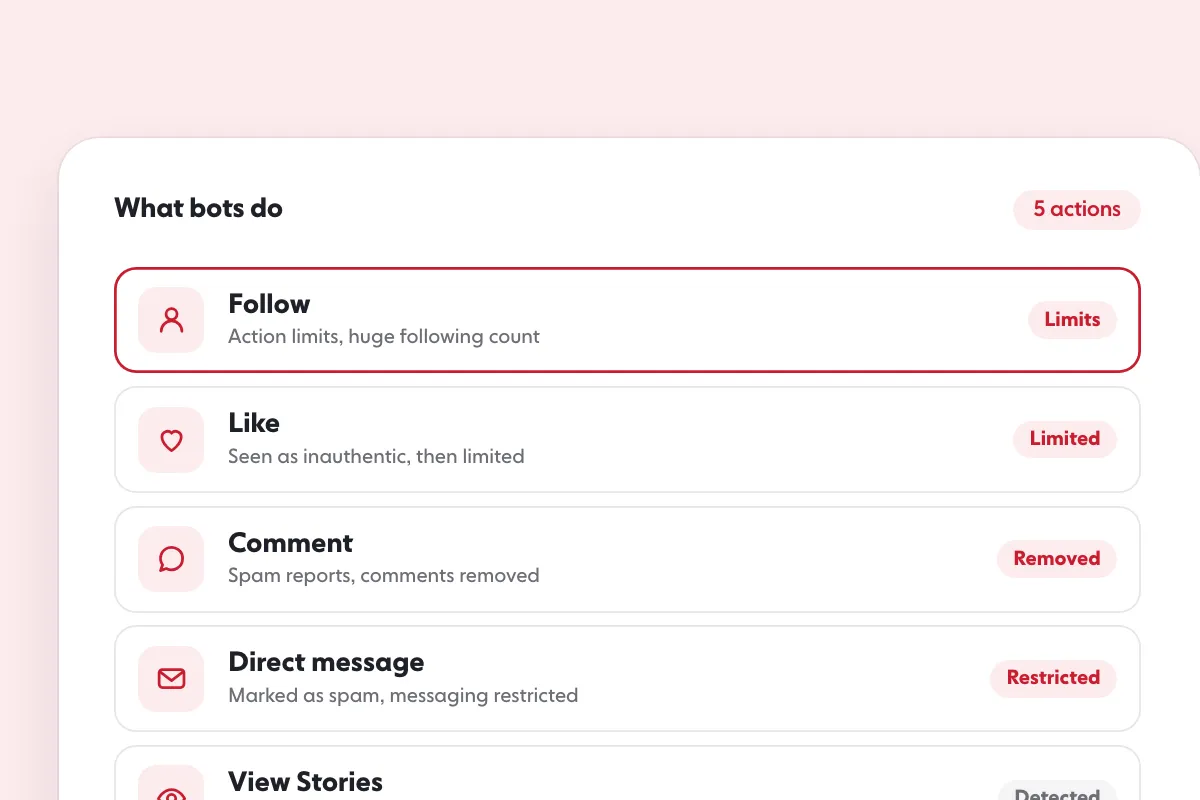
Instagram Bots: 5 Things They Do and the Risks of Each
Growth services
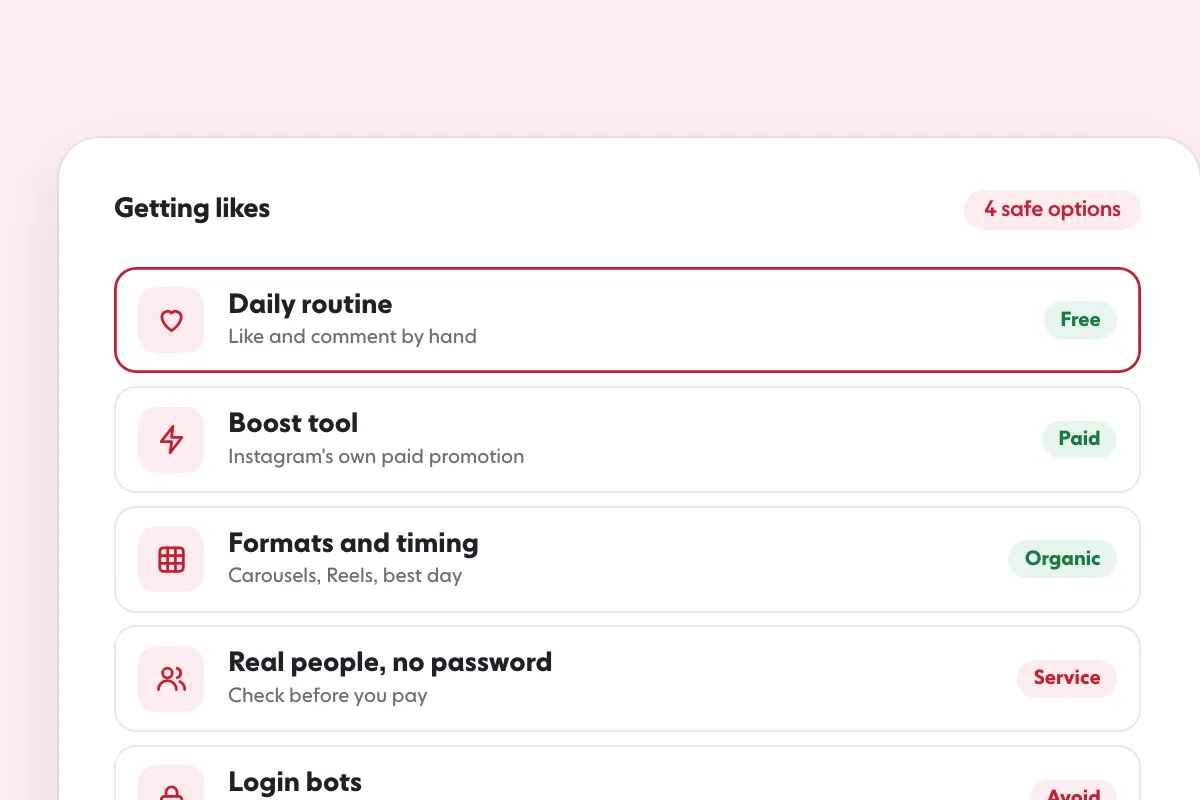
Instagram Auto Likes: How They Work, Risks, 4 Safe Options
Written by Jonas Revel
Research editor
Jonas Revel runs research on the SocialCaptain blog: the statistics pages, account safety, and the fact-check every article gets before it goes live. Each number is traced to its original source and dated, and figures that cannot be traced are left out.
All articles by Jonas Revel


